LifeGraph®: The Trusted Foundation for Enterprise-Level Agentic AI
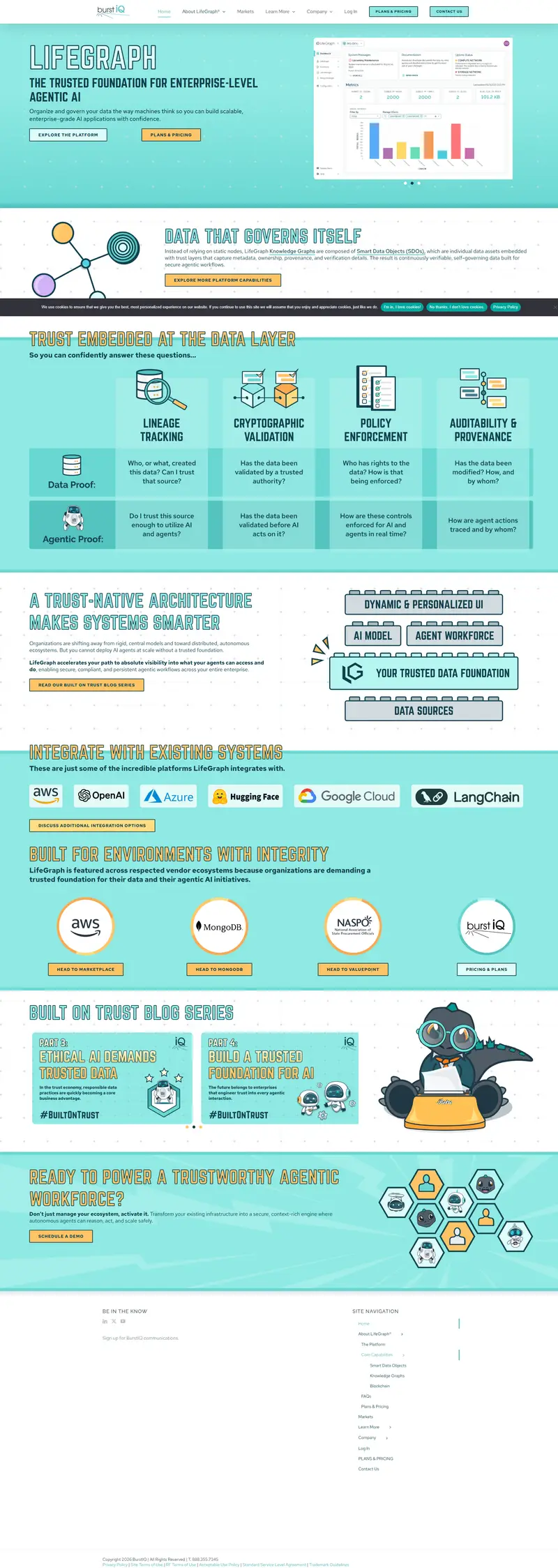
Desktop · Light · scroll within frame to see full page
Design System Inspiration
Burstiq — extracted via DESIGN.md
AI/ML · Agentic AI foundation
Typography
Raleway
Heading
Red Hat Text
Body
Color palette
TL;DR
Burstiq utilizes a "monochrome-plus" strategy where a stark white canvas (`#ffffff`) and slate-gray typography (`#47515a`) are energized by a primary teal (`#53c2bf`) and secondary amber (`#ffc467`). The visual language is deeply rooted in "data architecture" motifs, specifically using a light gray dot-grid background and thin black hairlines (`#000000`) for component borders. Buttons are strictly rectangular with 0px radius, relying on high-contrast fills and 1px solid borders to denote interactivity. The system balances heavy technical display type with a clean, high-legibility sans-serif for functional UI and body prose.
Target audience
The likely target audience is enterprise-level businesses and developers seeking AI solutions, focusing on secure and organized data foundations.
Full tech stack
Analytics
Meta description
LifeGraph® is the Trusted Foundation for Enterprise-Level Agentic AI that organizes your data the way machines think so you can build AI applications with confidence.
Brand Voice
Authoritative, technical, and security-focused prose that emphasizes trust and autonomy in AI data management.
Positioning
BurstIQ provides LifeGraph, a trust-native data foundation for enterprise-level Agentic AI. It is designed for organizations building scalable, autonomous AI ecosystems that require verifiable data governance and cryptographic validation.
Voice principles
- —Authoritative: Uses strong, definitive statements about the future of data (e.g., "Data That Governs Itself").
- —Technical: Employs precise industry terminology like "cryptographic validation," "lineage tracking," and "provenance" without over-explaining.
- —Trust-Centric: Repeatedly anchors technical features to the concept of "trust" and "confidence" to mitigate the risks of AI.
- —Action-Oriented: Uses active verbs to describe what the platform does for the user (e.g., "organize," "govern," "accelerate," "activate").